Chanakya Monologue 1

तुम्हारे पतन का कारण तुम स्वयं हो। 
हमारे पतन का कारण हम स्वयं हैं। 

कोई भी मूल्य एवं संस्कृति तब तक जीवित नहीं रह सकती, जब तक वह आचरण में नहीं है। 
झूठ कहते हैं वे लोग जो दूसरे सम्प्रदायों के उदय को अपनी आस्था के पतन का कारण मानते हैं।
आस्था तुम्हारी है वह डिग कैसे सकती है। 
और यदि तुम्हारी आस्था को सत्य का आधार नहीं है तो उसका पतन होना चाहिए। 

तुम्हारा मार्ग भिन्न हो सकता है। 
उसका मार्ग भिन्न हो सकता है। 
सत्य तक पहुँचने के मार्ग भिन्न-भिन्न हो सकते हैं। 
इसलिए जो अपने मार्ग पर अपने साथ नहीं, उसका मार्ग गलत है। 
यह मानना गलत होगा।
"एकम सत्यम विप्रा बहुधा वदन्ति"
एक ही सत्य को विद्वान अलग-अलग रूपों में व्यक्त करता है। 
सम्प्रदाय मार्ग हो सकते हैं लक्ष्य नहीं। 
साधक और साध्य के बीच साधना है। 
साधना भी एक मार्ग है। 
वह विभिन्न हो सकता है। 
एक ही संस्कृति के अनुयायियों की साधना विभिन्न हो सकती है। 
अतः साधना की भिन्नता से, संप्रदायों की भिन्नता से हमारी संस्कृति में भेद नहीं हो सकता है। 

संस्कृति तो सत्यनिष्ठ जीवन मूल्य है। 
जीवन की एक पद्धति है जिसके हम सभी अनुयायी हैं। 
जीवन में हमारी आस्था है, यह हमारी संस्कृति है। 
यह हमारा संस्कार है। 
जो सत्य से परामुख हो वह हमें स्वीकार नहीं है। 
यह हमारी पद्धति है। 
यह हमारा अनुशासन है। 

और यही संस्कृति हमें भिन्न-भिन्न उपासना के मार्ग देती है। 
जीवन की एक पद्धति और उपासना की दूसरी पद्धति में कोई संघर्ष नहीं है। 
जब तक वह सत्यनिष्ठा नहीं है। 
इसलिए दूसरों का मार्ग तुम्हारे मार्ग से भिन्न हो तो चिंता मत करो। 
विचलित मत हो। 
अपनी आस्था को संजो कर रखो। 
अपने मूल्यों का जतन करो। 
और समय-समय पर उनका मूल्यांकन करो। 
सत्य के प्रकाश में अपनी परंपराओं को देखो और उनका विश्लेषण करो। 

जब तक तुम सत्य की रक्षा करोगे, संस्कृति तुम्हारी रक्षा करेगी। 
यह तो सीधी समझ में आने वाली बात है। 

यदि आज तुम असुरक्षित महसूस कर रहे हो, तो कारण बाहर नहीं भीतर है। 

सत्य का मार्ग तुम छोड़ते हो तो चुनाव के लिए कौन सा मार्ग शेष रह जाता है। 

यही तुम्हारे पतन का कारण है। 
और यही समाज के पतन का भी कारण। 

चुनौती स्वीकार करने के बजाय आप द्वेष करते हैं, घृणा करते हैं। 
दुसरो को चुनौती देते हैं। 
यदि सत्यनिष्ठ मूल्यों में तुम्हारी इतनी ही आस्था है तो उन्हें जी कर दिखाओ। 
तुम्हारा कृतत्व ही तुम्हारा इतिहास हो सकता है। 
और अपना इतिहास बनाने का तुम्हें अधिकार है। 
सामर्थ्य है तो उठकर दिखाओ। 
जी कर दिखाओ, कर के दिखाओ। 
उदाहरण रखो। 
उदाहरण बनो। 
किसने तुम्हें रोक रखा?


Viruddh Aahaar - What Not to with What - Aayurveda science of Antagonistic food

विरोधी आहार के सेवन से बल, बुद्धि, वीर्य व आयु का नाश, नपुंसकता, अंधत्व, पागलपन, भगंदर, त्वचाविकार, पेट के रोग, सूजन, बवासीर, अम्लपित्त (एसीडिटी), सफेद दाग, ज्ञानेन्द्रियों में विकृति व अष्टौमहागद अर्थात् आठ प्रकार की असाध्य व्याधियाँ उत्पन्न होती हैं। विरुद्ध अन्न का सेवन मृत्यु का भी कारण हो सकता है।

- जो पदार्थ रस-रक्तादी धातुओं के विरुद्ध गुणधर्मवाले व वात-पित्त-कफ इन त्रिदोषों को प्रकुपित करनेवाले हैं, उनके सेवन से रोगों की उत्पत्ति होती है | इन पदार्थों में कुछ परस्पर गुणविरुद्ध, कुछ संयोगविरुद्ध, कुछ संस्कारविरुद्ध और कुछ देश, काल, मात्रा, स्वभाव आदि से विरुद्ध होते हैं |

जैसे-दूध के साथ मूँग, उड़द, चना आदि सभी दालें, सभी प्रकार के खट्टे व मीठे फल, गाजर, शककंद, आलू, मूली जैसे कंदमूल, तेल, गुड़, शहद, दही, नारियल, लहसुन, कमलनाल, सभी नमकयुक्त व अम्लीय प्रदार्थ संयोगविरुध हैं | दूध व इनका सेवन एक साथ नहीं करना चाहिए | इनके बीच कम-से-कम २ घंटे का अंतर अवश्य रखें |

- ऐसे ही दही के साथ उड़द, गुड़, काली मिर्च, केला व शहद; शहद के साथ गुड़; घी के साथ तेल नहीं खाना चाहिए |

- शहद, घी, तेल व पानी इन चार द्रव्यों में से दो अथवा तीन द्रव्यों को समभाग मिलाकर खाना हानिकारक हैं |

- गर्म व ठंडे पदार्थों को एक साथ खाने से जठराग्नि व पाचनक्रिया मंद हो जाती है |

- दही व शहद को गर्म करने से वे विकृत बन जाते हैं |

- दूध को विकृत कर बनाया गया छेना, पनीर आदि व खमीरीकृत प्रदार्थ (जैसे-डोसा, इडली, खमण) स्वभाव से ही विरुद्ध हैं अर्थात इनके सेवन से लाभ की जगह हानि ही होती है |

- रासायनिक खाद व इंजेकशन द्वारा उगाये गये आनाज व सब्जियाँ तथा रसायनों द्वारा पकाये गये फल भी स्वभावविरुद्ध हैं |

- हेमंत व शिशिर इन शीत ऋतुओं में ठंडे, रुखे-सूखे, वातवर्धक पदार्थों का सेवन, अल्प आहार तथा वसंत-ग्रीष्म-शरद इन ऊष्ण ऋतुओं में ऊष्ण पदार्थं व दही का सेवन कालविरुद्ध है |

- मरुभूमि में रुक्ष, उषण, तीक्षण पदार्थों (अधिक मिर्च, गर्म मसाले आदि) व समुद्रतटीय प्रदेशों में चिकने-ठंडे पदार्थों का सेवन, क्षारयुक्त भूमि के जल का सेवन देशविरुद्ध है |

- अधिक परिश्रम करनेवाले व्यक्तियों के लिए रुखे-सूखे, वातवर्धक पदार्थ व कम भोजन तथा बैठे-बैठे काम करनेवाले व्यक्तियों के लिए चिकने, मीठे, कफवर्धक पदार्थ व अधिक भोजन अवस्थाविरुद्ध है | - अधकच्चा, अधिक पका हुआ, जला हुआ, बार-बार गर्म किया गया, उच्च तापमान पर पकाया गया (जैसे-ओवन में बना व फास्टफूड), अति शीत तापमान में रखा गया (जैसे-फिर्ज में रखे पदार्थ) भोजन पाकविरुद्ध है |

- मल, मूत्र का त्याग किये बिना, भूख के बिना अथवा बहुत अधिक भूख लगने पर भोजन करना क्रमविरुद्ध है |

- जो आहार मनोनुकूल न हो वह ह्रदयविरुद्ध है क्योंकि अग्नि प्रदीप्त होने पर भी आहार मनोनुकूल न हो तो सम्यक पाचन नहीं होता |

- इस प्रकार देश, काल, उम्र, प्रकृति, संस्कार, मात्रा आदि का विचार तथा पथ्य-अपथ्य का विवेक करके नित्य पथ्यकर पदार्थों का ही सेवन करें | अज्ञानवश विरुद्ध आहार के सेवन से हानि हो गयी हो तो वमन-विरेचनादी पंचकर्म से शारीर की शुद्धी एंव अन्य शास्त्रोक्त उपचार करने चाहिए | आपरेशन व अंग्रेजी दवाएँ रोगों को जड़-मूल से नहीं निकालते | अपना संयम और नि:सवार्थ एंव जानकार वैध की देख-रेख में किया गया पंचकर्म विशेष लाभ देता है | इससे रोग तो मिटते ही हैं, १०-१४ वर्ष आयुष्य भी बढ़ सकता है |

- नासमझी के कारण कुछ लोग दूध में सोडा या कोल्डड्रिंक डालकर पीते हैं | यह स्वाद की गुलामी आगे चलकर उन्हें कितनी भारी पड़ती है, इसका वर्णन करके विस्तार करने की जगह यहाँ नहीं है | विरुद्ध आहार कितनी बिमारियों का जनक है, उन्हें पता नहीं | खीर के साथ नमकवाला भोजन, खिचड़ी के साथ आइसक्रीम, मिल्कशेक - ये सब विरुद्ध आहार हैं | इनसे पाशचात्य जगत के बाल, युवा, वृद्ध सभी बहुत सारी बिमारियों के शिकार बन रहे हैं | अत: हे बुद्धिमानो ! खट्टे-खारे के साथ भूलकर भी दूध की चीज न खायें- न खिलायें 

can you Evaluate your Life

If you were to look back and evaluate your life YOY (year-on-year), how would you rate the actions and experiences of your life...

1. 
Luck rating
Was that the year where you gained more by sheer luck than by your actions?

2. 
Call-vs-Action rating
Did you do what was expected of you?

3. 
Future-vs-Action rating
Did you do not what was needed for the moment, but did something that would be needed in the future?

4. 
Recreational-Happiness rating
If you spent the majority of your time not doing your regular office/study, but instead put your time enjoying, traveling, entertaining, etc., did it actually bring happiness to you?

5.
Relationship-Happiness rating
In whatever relationships you were (including being single, or parents-son, brother-sister, friends, marriage, love-affair, etc.), how many of them were actually giving you happiness?

6.
Job/Study-Happiness rating
If you spent the majority of your time doing your regular office work or studies did it actually bring happiness to you? Were you working in the field, area, domain, sector, industry, role you wanted to?

7.
Unfortunate-but-Fruitful rating
Was there a case that year, where something unfortunate or ugly happened to you, but in the long run, it actually turned out to be good for you (maybe because it made you stronger, or maybe because it let you go of something good but later brought something better in its place)?

7.
Ugly-and-Disastrous rating
Did any unfortunate or ugly event happen to you, which broke/destroyed you from inside?


Shri Krishna explains - Karma or Destiny - what is more powerful ?

महाभारत युद्ध में, श्री कृष्ण और कर्ण के बीच, एक बार ये बातचीत हुई:


कर्ण:

मेरी माँ ने मुझे उस पल छोड़ दिया जब मैं पैदा हुआ।

क्या यह मेरी गलती है कि मैं एक नाजायज बच्चा पैदा हुआ?

मुझे द्रोणाचार्य से शिक्षा नहीं मिली क्योंकि मैं एक क्षत्रिय नहीं था।

परशुराम ने मुझे पढ़ाया लेकिन फिर मुझे यह झूठ बोलने के कारण कि "मैं एक क्षत्रिय नहीं हूँ" सब कुछ भूल जाने का शाप दे दिया - जबकि उस समय मैं खुद नहीं जानता था की मैं एक क्षत्रिय हूँ।

मेरे तीर के सामने एक गाय अकस्मात आ गई और मर गयी - और इसके मालिक ने बिना किसी दोष के मुझे शाप दिया।

मुझे द्रौपदी के स्वयंवर में अपमानित होना पड़ा।

कुंती ने सिर्फ अपने बेटों को बचाने के लिए ही मुझसे सच कहा।

फिर मुझे जो कुछ भी मिला वह दुर्योधन के दान के माध्यम से था - तो मैं दुर्योधन का पक्ष लेने में कैसे गलत हूँ?

श्री कृष्ण जी ने कर्ण की बात सुनी, और कहा:

मेरा जन्म एक जेल में हुआ था।

मेरे जन्म से पहले ही मृत्यु मेरी प्रतीक्षा कर रही थी।

जिस रात मैं पैदा हुआ था, मैं अपने माता-पिता से अलग हो गया था।

बचपन से ही आप तलवारों, रथों, घोड़ों, धनुष और तीरों का शोर सुनकर बड़े हुए लेकिन मेरा बचपन गायों के झुंड और गोबर के बीच गुज़रा।

बचपन से ही मुझे मारने के लिए कई कोशिशें की गयीं ।

मैंने कई लोगों से सुना कि मैं ही उनकी सभी समस्याओं का कारण हूं।

जब आप सभी अपने शिक्षकों द्वारा अपनी वीरता के लिए सराहे जा रहे थे - सैन्य शिक्षा की तो बात ही छोड़ दो मुझे तो औपचारिक/गुरुकुल शिक्षा भी बहुत देर से मिली।

आपने अपनी पसंद की लड़की से शादी की - मुझे जिस लड़की से प्यार था उससे तो मेरी शादी नहीं हुई, उल्टा उन से शादी हुई जिन्हें मैंने राक्षसों से बचाया था।

मुझे अपने पूरे समुदाय को जरासंध से बचाने के लिए यमुना के तट से दूर समुद्र के किनारे तक ले जाना पड़ा - जिसके लिए मुझे कायर कहा गया।

अगर धुरोधन युद्ध जीतता है तो आपको बहुत सारा श्रेय मिलेगा।

अगर धर्मराज युधिष्ठिर युद्ध जीतते हैं तो मुझे क्या मिलेगा - युद्ध और सभी संबंधित समस्याओं का सारा दोष।

श्री कृष्ण जी ने आगे कहा:

हर किसी के भाग्य में चुनौतियां होती हैं - लेकिन कोई फर्क नहीं पड़ता कि हमें कितनी अनुचितता मिली, हमें कितनी बार अपमानित किया गया, कितनी बार हमें वो नहीं मिला जिस पर हमारा अधिकार था - महत्वपूर्ण ये है की आपने उस समय क्या कर्म किया !!!

भाग्य कभी भी किसी को भी अधर्म करने का अधिकार नहीं देता है | धर्म और अधर्म आपके कर्म से निर्धारित होते हैं, ना कि आपके भाग्य से !

जीवन कर्म से परिभाषित होता है, ना कि भाग्य से!

कर्म का पलड़ा भाग्य से अनंत-गुना बड़ा है!

the rise & rise of Sundar Pichai - the CEO of Google / Alphabet


“It is always good to work with people who make you feel insecure about yourself.
That way, you will constantly keep pushing your limits.”
- Sundar Pichai

Pichai Sundararajan, better known as Sundar Pichai, is the CEO of Alphabet company that owns Google & many other companies. Pichai joined Google in 2004 and became its CEO in 11 years.

This is his story:

Pichai’s family was from a modest background in Chennai. His father saved for three years to buy their first scooter, and sacrificed a lot more to ensure that Pichai and his brother got the best education they could. The brothers used to sleep in the bedroom which was also their living room. The family used to take the bus or their scooter to travel across town. His father was an electrical engineer and his mother was a stenographer.

Pichai used to listen to his father about the challenges at his  work as an electrical engineer, and that eventually got him curious about technology. At the age of 12, he developed an aptitude for numbers when his family bought a telephone. He could remember every number dialled during the day.

Pichai excelled at school, and was also the captain of the cricket team in high school. He pursued his B.Tech in Meallurgical Engineering from IIT Kharagpur, and then won a scholarship to study material sciences and semiconductor physics from Stanford University.

Much of the money that Pichai’s parents had in savings was used to buy his air tickets to Stanford. His degree in material sciences and semiconductor physics, would later on be of groundbreaking use to the developments at Google. In 1997, he dropped the idea of pursuing an an academic career, and decided to drop out of his PhD at Stanford. He then joined Applied Materials, a semiconductor maker in Silicon Valley, as an Engineer and Product Manager, and soon went to pursue his MBA at the Wharton School.

Pichai joined the Wharton School of Business for his MBA, where he was named a Siebel Scholar and a Palmer Scholar. He graduated from Wharton in 2002, to join McKinsey & Company as a management consultant. Pichai realized that moving to Google would be a suitable career move, after trying to convince a McKinsey colleague to avoid that exact thing. Pichai joined Google on April Fools’ Day in 2004. Interestingly, it was the same day when Gmail was introduced to the world.

Pichai joined Google as a soft-spoken manager, to work on Google’s search toolbar. The toolbar was made with a goal to give Internet Explorer and Firefox users an easy access to Google search. The toolbar’s success motivated Pichai to think of Google having its own web browser. Eric Schmidt, the then-CEO of Google, thought that it wasn’t worth the cost.

However, Pichai had immense belief in the idea and ultimately convinced the founders of Google, Larry Page and Sergey Brin, to launch Google’s own web browser, called Google Chrome. Pichai led the launch of Chrome that went on to become the best web browser in the world, surpassing both Internet Explorer and Firefox. This earned Pichai worldwide recognition in 2008, and he became the Vice President of product development at Google.

From 2008 to 2013, Larry Page ensured that Pichai’s rise in Google was rapid. In 2011, Pichai was considered to head product development at Twitter, but he decided to stay with Google. In 2013, when Android creator Andy Rubin left for Google’s robotics project, Pichai was asked to take over Android too. Pichai led the rapid growth of Android’s app ecosystem. In 2014, Pichai almost became the third CEO of Microsoft, but Google managed to retain him.

Pichai was not just a business savvy professional with great technical skills, but an excellent leader and diplomat too. He is known for building strong teams, avoiding office politics, and respecting everyone’s opinion. When Google decided to form its parent company, Alphabet Inc., Sundar Pichai succeeded Larry Page as the CEO of Google. Pichai, the man behind Google Chrome, now heads all products at Google, including Ads, Android, Apps, Maps, Search and YouTube.

Credit:
Careerguide.com/blog/inspirational-stories/career-story-sundar-pichai-google-gem

Kapil Dev - the greatest Indian Cricketer - an all-rounder champion captain

Wadekar was an excellent captain but he never won a World Cup.

Dhoni won a World Cup but he does not have hat-tricks.

Kuldeep has hat-tricks but he is not an outstanding fielder.

Jadeja is an incredible fielder but he doesn't have even two thousand Test runs.

Tendulkar has a lot of Test runs but not even fifty Test wickets.

Bumrah has over fifty Test wickets but does not stay fit.

Pujara does not get injured a lot but has played only 5 ODIs.

Agarkar has played a lot of ODIs but never led India.

Ganguly has led India many, many times but never coached India.

Anshuman Gaekwad coached India but never won a Ranji Trophy as captain.

Gavaskar won the Ranji Trophy but never a Test series in England.

Dravid won a series in England but never got India's record ODI score.

Rohit holds India's record ODI score but never had India's best ODI figures.

Ayub had India's best ODI figures but not 400 Test wickets.

Harbhajan has 400 Test wickets but not 5,000 runs.

Laxman has over 5,000 runs but never a 9-wicket haul.

Gupte had a 9-wicket haul but not hundreds in South Africa.

Azhar had one in South Africa but not one in West Indies.

Sardesai had hundreds in West Indies but never one in England.

Vengsarkar had hundreds in England but never hit four sixes in a row.

Yuvraj hit more than that but never took eight in an innings in Australia.

Kumble has done that but he never held the world record for most Test wickets.

But only 1 Indian has done all this - Every single one and more.
India's greatest ever cricketer!
Kapil Dev


Credit:
Whatsapp forward

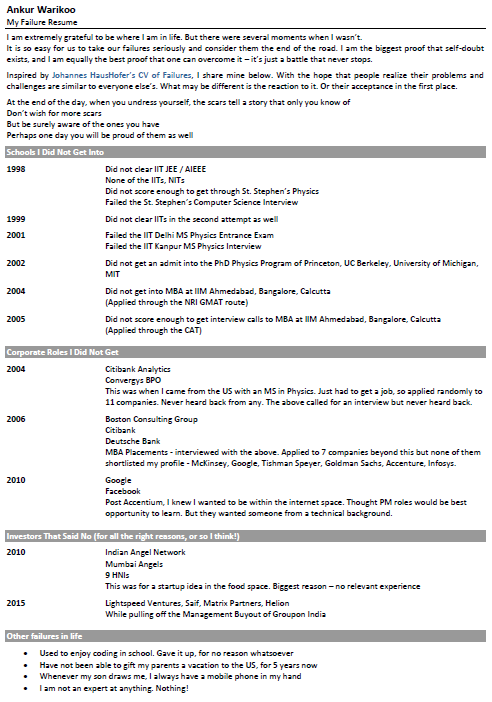
Ankur Warikoo - Founder-CEO of Nearbuy / Groupon, ex-MD of at Rocket Internet India, Co-founder of Accentium - Wrote his Failure resume


Credit:
http://www.ankurwarikoo.com/wp-content/uploads/2016/06/Ankur-Warikoo-Failure-Resume-1.pdf
https://en.wikipedia.org/wiki/Ankur_Warikoo

5 Questions that decide SUCCESS & FAILURE in all Endeavors of Life


***** the 5 Questions *****

"What you should do" or "What you should REALLY do"

Understand this question with an example -
When Lord Shri Krishna was 16 years old, his guru Sandipani Muni came and told him that he has a greater purpose in life. Krishna struggles and replies that he doesn't need/want it, as he already loves what he was, where he was, and with whom he was - i.e. in the village enjoying life with villagers and cattle. After a long discussion, Krishna finally agrees to his teacher's words and takes the next steps, as directed by him...

So, the point is, this question of what you should do, can be answered only by a person who has an insight into the future - by your mentor or a visionary, but in today's times, even their answers can be questionable/doubtful.

"What life expects you to do"

Here 'Life' is a metaphor for the situations and people around us.
What these people want/need from us, can be in total contrast to what we want to do.

"What you want you to do"

You can always have a divided thought on what you want to do - because it is very much possible that you want to do something for achieving a short-term-goal, while you want to do something entirely different for achieving a long-term-goal...

"What you can do"

What you can do is mostly defined by what you are good at - what skills do you possess - you might have come in possession of these skills either naturally or by study/practice

"What you are doing"

This is pretty simple, I guess... 

***** How to Decide *****

Lets say, following are the answers to your questions:

What you should do -
Travel the world. Start a traveling youtube channel (as suggested by your mentor)

What life expects you to do - 
Helping your father in his almost-dead business

What you want you to do - 
Acting in web series

What you can do - 
Writing (but you are not doing it, as it does not generate much money)

What you are doing - 
Sales job

So, returning to the original question, how do you decide, how to achieve success?

Answer - TBD


Credits:
Youtube.com/watch?v=h2VxHuKF3Ps

what is One plus One

For illiterate:
1+1 = unknown

For poor:
1+1 = 0

For lovers:
1+1 = 1

For middle-class:
1+1 = 2

For smart people:
1+1 = 3

For computer-software-programmers:
1+1 = 10

For businessmen:
1+1 = 11

But, for Kautilya (the great strategist):
1+1 = What he wants it to be

Daily habits and Life tips - for Success & Health

Few habits & life-tips that you can follow daily:

1. Always sleep to your left side

2. Read 1 new word daily morning - and try to use it over the day in your conversations

3. Slightly massage your gums with your finger after brushing your teeth

4. Sleep for 6 (min) to 8 (max) hours daily

5. Fix your body clock - wake, eat, sleep, etc at the same time daily

6. Take a break of 5 mins after every 50 mins of brain-activity

7. If you are learning something new, learn it in smaller daily chunks of 100 mins

8. Walk for 30 (min) to 50 (max) mins daily

9. Ideal distance for reading/writing should be 15 (min) to 25 (max) inches from the eyes

10. Eat 5 almonds daily (preferred - morning on an empty stomach) and 2 walnuts

11. Do Anulom-Vilom (breathing exercise) for 5 (min) to 10 (max) mins daily

12. Have 1 cup of Green Tea daily

13. Fast for 1 day every fortnight - Consume only Water that day

14. Keep your body hydrated - Keep drinking water and keep urinating (Prefer drinking water stored in a copper-lota)

15. Don't let your body go without food for more than 8 hours - plan your breakfast, lunch, dinner, and other eating timings accordingly

16. Never skip your breakfast (prefer having a heavy breakfast before sunrise)

17. To maintain body-weight, either increase output (exercise) or reduce input (food)

18. Wash your hands with soap for 20 seconds - count till 30 if you don't have a watch!

All of the above points have been taken from the internet and are not any doctor's advice...

Eating correct food & Correctly eating food

Food is a compulsory necessity of our human body.

Following are some MUST-DOs & NEVER-DOs of Eating that if followed can do wonders:

1.
Reduce the amount of Salt, Sugar, White flour (Maida) in your diet as much as possible.
Reason:
Salt increases blood pressure.
Sugar drains calcium. Maida kills probiotics.

2.
Never eat raw-veggies and cooked food together.
If fruits/salads are to be eaten, eat them 45 mins before eating cooked food.

3.
Eat a very-heavy breakfast before morning (9am), followed by a tummy-filling lunch at noon (1pm), followed by a light dinner at evening (5pm).
Do not eat anything after evening (5pm).
If you feel hungry after 5pm, have warm milk at night (9pm).

4.
Drink fruit juices with breakfast & butter-milk with lunch.

5.
Always eat while sitting on the ground (else on a chair).

6.
Always eat warm food.
Never eat cold food.

7.
Within 45 mins of having food don't:
Sleep or Yawn or Loosen-your-tummy-belt or Walk or Run or Piss or Shit

8.
Enjoy what you eat.
Be happy when you eat.
Avoid eating when you are either angry or sad.
While eating, concentrate on eating and don't think of anything else while eating.
Don't speak/talk during the entire duration while you are eating.
Let eating be like meditation to you.

9. 
Chew your food 40 times in your mouth before swallowing it down to your stomach.

10.
Amount of cooked vegetables should always be double the amount of bread that you eat together.

11. 
Make lemon, ginger, raw-veggies, probiotics, carrot (was initially grown as medicine), pepper, part of your daily food intake.

12.
Eating probiotics (curd, apple vinegar, fermented vinegar) empty stomach will increase the quantity of good bacteria in stomach and will hence improve digestion.

13.
If needed, once a week Trifala Churana (1TbSp with 2 mouthful of warm-water) can be consumed after dinner once in a week.

14.
Have min 1 and max 2-3 cups of Green tea daily.

15. 
Avoid these:
  • Deep fried foods
  • Sausages
  • Butter (prefer cow-ghee instead)
  • Fast-food
  • Sodas & cold-drinks
  • Milk-tea or Milk-coffee (have black tea/coffee instead)
  • Sweets made using sugar (instead, prefer the ones made with jaggery)
16. 
Follow Water-drinking rules (click here to read).

17. 
Excess of any food; no matter how medicinal it is; is similar to taking poison (so, eat ONLY 1 apple, ONLY 5 almonds, only 2 eggs, etc. - in a day).

18. 
Avoid plastic or aluminium containers for storing eatable & drinks (especially if/when the eatable/drink is hot/warm).
Prefer food-grade plastic or steel or glass or copper instead.

19.
Don't cook food in non-stick or aluminium utensils.
Prefer Copper or Steel or Hard anodized aluminium. 

All of the above points have been taken from the internet and are not any doctor's advice...

if Water can Build & it can Destroy too

Water is a compulsory necessity of our human body.

But there are certain MUST-DOs & NEVER-DOs of Water-Drinking:

1. Never drink cold water - Always drink warm or normal-temperature water

2. Drink water only 45 mins before & 45 mins after having food or fruits - Don't drink water with food - If needed, drink warm-water with food

3. Always sit and drink water

4. Drink water slowly (small gulp at a time) - Don't drink all water in 1 go - Take 1 small gulp of water and rotate it in your mouth and then swallow it

5. Don't drink water with fruits

6. Don't drink water within 15 mins after urinating

7. Drink only when you feel thirsty & drink only that much amount that you feel like drinking

8. Drink 1 cup of water before taking a bath

9. Drink minimum 1 glass or max 1 ltr of water immediately after waking up - warm water at this time will have additional benefits

10. Avoid drinking water just before sleeping - Drink no more than 2 gulps of water before sleeping

11. Empty your bladder before going to bed at night.

All of the above points have been taken from the internet and are not any doctor's advice...

one of the most powerful Shloka of Bhagavad Gita - Yada yada hi Dharmasya

One of the most powerful shloka in Bhagavad Gita:

यदा यदा हि धर्मस्य ग्लानिर्भवति भारत ।
अभ्युत्थानमधर्मस्य तदात्मानं सृजाम्यहम् ।।7।।

परित्राणाय साधूनां विनाशाय च दुष्कृताम् ।
धर्मसंस्थापनार्थाय संभवामि युगे युगे ।।8।।

Meaning in Hindi:

भारत = हे भारत; यदा = जब; यदा = जब; धर्मस्य = धर्म की; ग्लानि: = हानि (और ); अधर्मस्य = अधर्म की; अभ्युत्थानम् = वृद्वि; भवति =होती है; तदा = तब तब; हि = ही; अहम् = मैं; आत्मानम् = अपने रूप को; सृजामि = रचना हूं अर्थात् प्रकट करता हूं।

साधूनाम् = साधुपुरुषों का; परित्राणाय = उद्धार करने के लिये; च = और; दुष्कृताम् = दूषित कर्म करने वालों का; विनाशाय = नाश करने के लिये (तथा ); धर्मसंस्थापनार्थाय = धर्म स्थापन करने के लिये; युगे = युग; युगे = युग में; संभावामि =प्रकट होता हूं।

Meaning in English:

Whenever and wherever there is a decline in religious practice, O descendant of Bharata, and a predominant rise of irreligion at that time I descend Myself.

In order to deliver the pious and to annihilate the miscreants, as well as to reestablish the principles of religion, I advent Myself millennium after millennium.